When to Use Centralized Fabrication vs. Local Fabrication
Centralized and local fabrication strategies are two approaches to how commercial stone is produced and coordinated across a project. Centralized fabrication consolidates production under a single controlled process, while local fabrication relies on regional production closer to the job site. The right approach depends on project scale, detailing complexity, repetition, and coordination requirements across design, fabrication, and installation.
Understanding Fabrication Strategy in Commercial Design
Fabrication strategy influences coordination across detailing, production, logistics, and installation—directly affecting execution risk and predictability.
It influences how project teams coordinate tolerances, maintain consistency, manage logistics, and reduce execution risk.
For architects working on large-scale commercial projects, the question is usually not which model is better in theory. The real question is which model better supports the project’s scope, schedule, detailing, and long-term performance expectations.
When Centralized Fabrication May Be the Right Fit
Centralized fabrication is often appropriate when projects require high levels of consistency, coordination, or repeatability across multiple assemblies or locations.Centralized fabrication is often appropriate for projects that involve:
- Multiple locations or phased rollouts
- Branded or standardized design elements
- Tight tolerance requirements across assemblies
- Complex detailing requiring unified quality control
- Coordination across multiple teams or regions
By consolidating production under a single process and quality framework, centralized fabrication can reduce variability, improve tolerance control, and support predictable execution across the full project scope.
When Local Fabrication May Be Appropriate
Local fabrication can be effective for projects with simpler scopes or limited geographic reach, where proximity and responsiveness are primary considerations.
Local fabrication may be well-suited for:
- Single-location projects
- Smaller-scale or less complex installations
- Situations where logistics, access, or scheduling favor nearby production
- Projects with limited repetition or standardization requirements
In these scenarios, close coordination between fabricator and installer may outweigh the need for centralized oversight, particularly when flexibility and on-site responsiveness are critical.
How Fabrication Strategy Affects Downstream Coordination
Fabrication strategy influences far more than where materials are produced. Decisions made early in design shape coordination across detailing, production, logistics, and installation—directly affecting execution risk and predictability.
As projects scale, fabrication strategy increasingly functions as a coordination tool rather than a sourcing decision.
Key downstream impacts include:
- Consistency across locations or phases
- Alignment with installation sequencing
- Communication between design, fabrication, and installation teams
- Reduction of field adjustments or rework
When fabrication strategy aligns with project complexity, teams experience fewer coordination gaps and more reliable outcomes throughout construction.
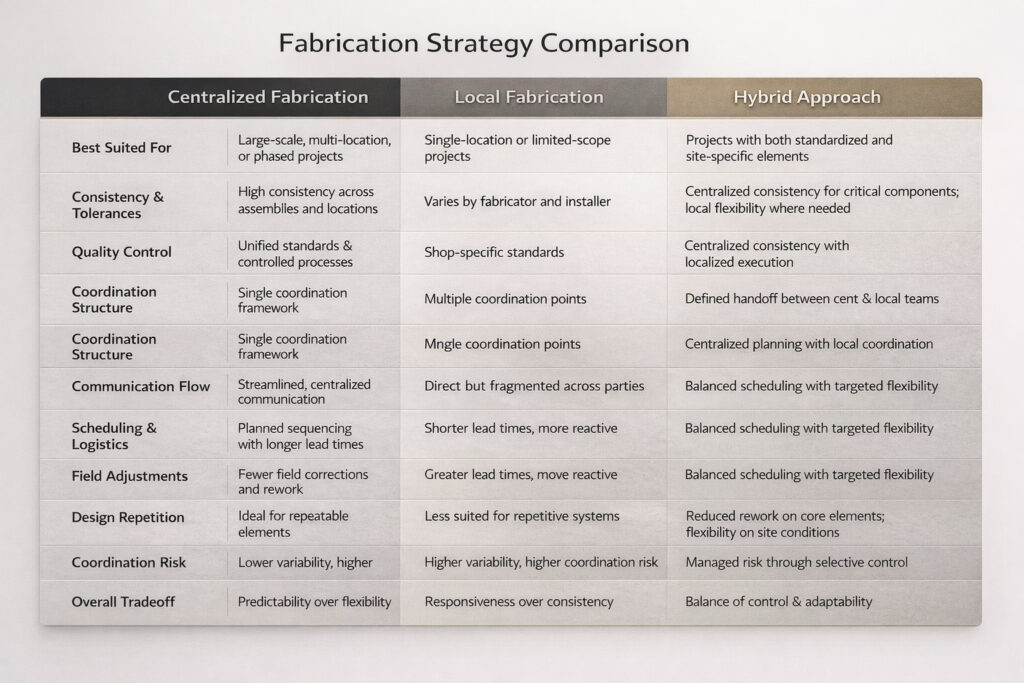
Balancing Proximity and Performance
In practice, many large-scale projects rely on hybrid strategies to balance quality control with on-site flexibility.
The primary consideration is how the selected approach supports:
- Design intent
- Constructability
- Long-term durability
- Predictable execution outcomes
Evaluating these tradeoffs allows architects to align fabrication strategy with project goals rather than defaulting to a single model.
Fabrication Strategy as an Early Design Consideration
Fabrication decisions are most effective when evaluated early in the design process. Early alignment allows project teams to:
- Anticipate coordination and tolerance requirements
- Align detailing with execution realities
- Reduce downstream risk during construction
By treating fabrication strategy as part of design planning—not merely procurement—architects can support more consistent and reliable outcomes across the project lifecycle.
Continue Exploring Fabrication & Installation Considerations
These considerations are most effective when applied to real project conditions. If you’re evaluating fabrication strategy for an upcoming project, our team can help align design intent with execution realities.
Frequently Asked Questions
These questions reflect common considerations architects and project teams evaluate when selecting a fabrication strategy for commercial stone projects.
When should architects consider centralized fabrication?
Centralized fabrication is often considered when projects involve multiple locations, complex detailing, phased schedules, or a need for consistent execution across regions.
Is centralized fabrication always better than local fabrication?
No. The appropriate approach depends on project scale, complexity, coordination needs, and logistics. Each model offers advantages in different situations.
How does fabrication strategy affect coordination?
Fabrication strategy influences consistency, communication, tolerance control, sequencing, and the likelihood of field adjustments during installation.
Can centralized and local fabrication be combined?
Yes. Some projects use hybrid approaches that balance centralized quality control with local fabrication or installation support.
When should fabrication strategy be evaluated during design?
Fabrication strategy is most effective when considered early, allowing detailing, coordination, and sequencing to align with execution realities before construction begins.
Continue Exploring Related Specification Considerations
Early design decisions are most effective when evaluated alongside fabrication methods, installation conditions, and real-world performance outcomes. The resources below expand on these related topics and provide additional context to support more informed, execution-ready specification decisions.
- How lunch and learn sessions support informed specification decisions
- How fabrication methods influence consistency, tolerances, and finish quality
- How installation conditions affect constructibility and long-term durability
- How early design decisions impact coordination, risk, and project outcomes
- How precedent supports material performance evaluation at scale
- When centralized vs. local fabrication makes sense for your project
View the full resource library for a complete view of commercial stone specification considerations.